
How Breathwork Benefits and Rewires Your Nervous System, Reframes Your Mind, and Unlocks Lasting Change
Breathwork has taken the limelight amongst wellness facilitators, health spas & personal growth seekers — and if you’ve been curious about what it actually does, you’re in the right place. Beyond the wellness trend, there’s a growing body of neuroscience, physiology research and centuries of ancient wisdom and practice that explains exactly why something as simple as the way you breathe can change your body chemistry, shift your emotional state, and over time, rewire the patterns running quietly in the background of your mind.
I’d like to break this down into: the two nervous system states, what breathwork does to each of them, and the fascinating neuroscience behind layering breath with visualisation, affirmation and sound.
Your Two-Mode Nervous System: Sympathetic vs Parasympathetic
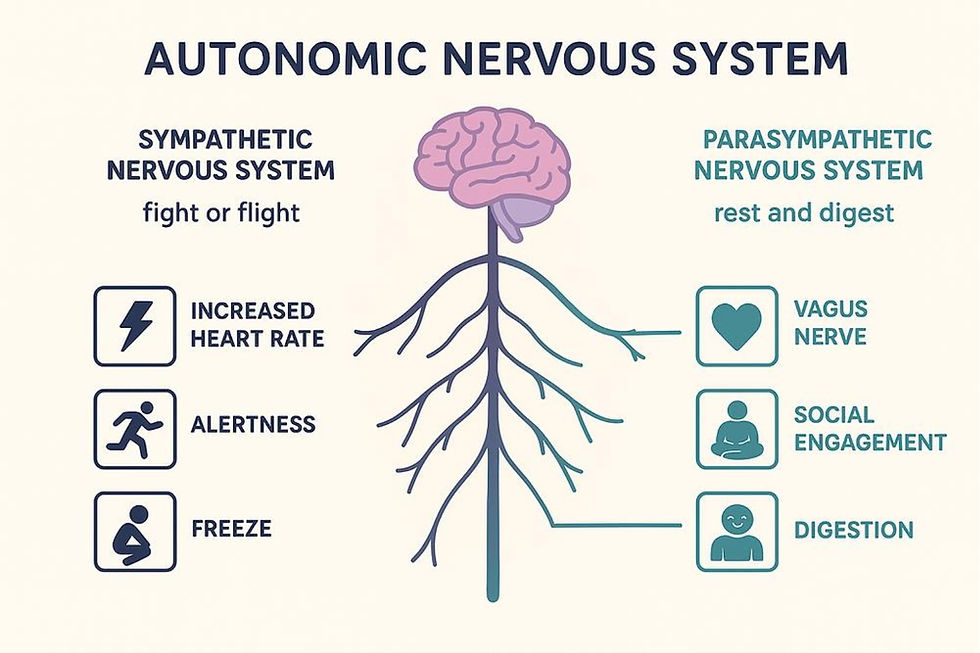
Your autonomic nervous system (ANS) runs almost everything that keeps you alive — heart rate, digestion, breathing, hormones — and it operates across two main states:
Sympathetic: The Activator
Often called “fight or flight,” the sympathetic nervous system is your body’s mobilisation system. When it activates, cortisol and adrenaline surge, heart rate climbs, digestion slows, and your entire system prioritises survival. This is an essential function — but in modern life, many of us are stuck in sympathetic overdrive: wired, reactive, and unable to switch off.
Parasympathetic: The Regulator
The parasympathetic nervous system is your “rest and digest” mode. When it’s dominant, heart rate slows, digestion resumes, inflammation reduces, and the body enters repair and recovery. This is the state where healing happens — and where genuine calm, clarity and creativity become accessible.
Optimal wellbeing isn’t about living exclusively in one state — it’s about having the flexibility to move between them fluidly. The research term for this is “autonomic flexibility,” and it’s considered one of the most important markers of nervous system health and resilience.
“Autonomic flexibility refers to the dynamic ability of the autonomic nervous system to adapt to internal and external stressors by shifting between sympathetic and parasympathetic dominance.” — PubMed, 2025
How Breathwork Works: The Science
Here’s what makes breathwork so powerful: it’s one of the only tools that gives you direct, conscious access to your autonomic nervous system. You can’t consciously control your heart rate or digestion — but you can control your breath, and through that, influence everything else.
The Vagus Nerve: Your Body’s Superhighway
Both activating and calming breathwork techniques stimulate the vagus nerve — the longest nerve in the body, running from the brainstem all the way down through the heart, lungs and gut. Vagal tone (how well this nerve functions) is closely linked to your ability to regulate stress, recover from challenge, and maintain emotional balance.
Research consistently shows that breathwork improves vagal tone and heart rate variability (HRV) — the measurable variation in time between heartbeats, and one of the most reliable biological markers of nervous system resilience. Slow breathing at around four to six breaths per minute has been shown to produce significant improvements in HRV, even after a single short session.
Slow, Parasympathetic Breath
Extended-exhale and diaphragmatic breathing techniques (resonance breathing, box breathing, 4-2-6 patterns) directly activate the parasympathetic nervous system. A 2025 review of thirty studies found that slow, diaphragmatic, nasal breathing measurably:
Lowers cortisol (our primary stress hormone)
Improves vagal tone and heart rate variability
Enhances emotional regulation
Reduces anxiety, depression and markers of psychological stress
Produces effects that carry beyond the session — changing how the body responds to the next stressor
Activating, Sympathetic Breath
Faster-paced breath — often in and out through the mouth in a controlled circular pattern, or in through the nose and out through the nose or mouth — intentionally activates the sympathetic system. Rather than creating unchecked stress, a skilled breathwork facilitator uses this to deliberately stimulate the stress response in a contained way, so the brain can register it and regulate it. This builds resilience, and creates a window for stored emotion, tension and stagnant energy to rise to the surface and be released.
Recent EEG research found that immersive breathwork sessions were associated with increased neural complexity — a state where the brain becomes more flexible, less rigid, and less locked into habitual patterns. This matters because rigid brain patterns are closely linked to anxiety, depression and emotional reactivity.
The Brain–Breath Connection: Visualisation, Affirmation and Subconscious Rewiring

Breathwork becomes significantly more powerful when it’s layered with visualisation and affirmation — and the neuroscience behind this is genuinely fascinating.
The Brain Doesn’t Draw a Hard Line Between Real and Imagined
UCL brain imaging research found that imagined and perceived experiences activate similar patterns in the visual cortex, and that the distinction between real and imagined is a difference of intensity, not category. The brain responds to the feeling you generate — not to whether the event is actually happening. This means that when you’re in a breathwork state and you vividly visualise a desired outcome or feeling, your nervous system begins to respond as though it is real.
“The body doesn’t know the difference between an experience and a thought. You can literally change your biology, chemistry, hormones and genes, simply by having an inner event.” — Dr Joe Dispenza
Accessing the Subconscious: Reframing and Rewiring Neural Pathways
Research suggests the subconscious mind drives an estimated 90–95% of our thoughts, behaviours and emotional responses. Most people’s conscious goals fail not because of lack of effort, but because the subconscious is running older, competing programs — patterns formed in childhood, through past experience, or through prolonged stress.
Breathwork creates a physiological state that makes the subconscious more accessible. In an activated or deeply regulated breath state, the analytical, critical mind quietens, and the brain enters a receptive mode where new beliefs can be imprinted more effectively. When affirmations and visualisation are introduced at this moment, they engage the brain’s neuroplasticity — its capacity to reorganise itself and form new neural pathways.
A 2025 study published in Communications Biology found that intensive mind-body practices produced measurable neural changes including:
Disruption of the default mode network (responsible for self-referential, habitual thinking)
Stronger connectivity between the prefrontal cortex and emotional regulation networks
Upregulation of BDNF — a key protein involved in the growth of new neural connections
Activation of endogenous opioid pathways (the body’s own pain-relief and reward chemistry)
Over time and with repetition, this rewires how the brain defaults to responding. Old patterns of anxiety, self-doubt or emotional reactivity lose their grip, and new patterns aligned with calm, clarity and possibility take root.
“When we think our thoughts and feel our feelings, our bodies respond in a complex formula of biological shifts and alterations.” — Dr Joe Dispenza
The Epigenetics Layer
Dr Joe Dispenza’s work takes this further, linking elevated emotional states paired with focused intention to epigenetic influence — the idea that thought and emotion can influence how genes express themselves (not the DNA sequence itself, but which parts get ‘switched on’). While this is still an evolving and not yet fully settled area of research, the broader direction of epigenetics science supports the premise that environment — including our internal emotional environment — plays a significant role in gene expression and overall biology.
Adding Sound: The Third Layer

When music and sound are layered into a breathwork session, the physiological impact expands further. Music has a well-documented effect on the brain’s reward and pain-relief chemistry: listening to music we enjoy reliably triggers dopamine release, and emotionally moving music can prompt endorphin release — the body’s natural opioids. This is part of why sound journeys often produce a sense of expansive, euphoric release that participants describe as unlike anything they’ve experienced through conversation or conventional therapy alone.
In a full breathwork and sound session, three systems are working simultaneously:
Breath — regulating the nervous system and creating the physiological window for change
Visualisation and affirmation — redirecting the felt internal state and reinforcing new neural pathways
Sound — adding chemical reward, deepening release, and anchoring the emotional experience
A Note on Safety and Who Breathwork Is For
Breathwork is suitable for most people, but a responsible practitioner always screens for contraindications before recommending a technique. Conditions including epilepsy, pregnancy, uncontrolled high blood pressure, cardiovascular disease, recent surgery, stroke, and chronic respiratory issues all require modification or a gentler approach.
If you’re unsure whether breathwork is appropriate for your specific health situation, I always recommend checking in with your GP first — particularly for activating or immersive styles. For online or self-guided practice, listen to your body, ease off if something feels too intense, and start gently.
Where to Start

If you’re new to breathwork, the best starting point is a qualified facilitator who takes time to understand what you’re working on — whether that’s stress, grief, a mindset block, hormonal imbalance, or simply a desire to feel more present and regulated. The technique that works best for you depends on where you are right now, and a good practitioner will meet you there.
At Luxe Wellness, I offer group breathwork sessions across Sydney, corporate wellbeing programs, and immersive retreat experiences — all designed around the intersection of science-backed practice and deep, felt transformation.
You are always in control of your own breath. It’s not done to you — it’s a dial you’re holding the whole time.
If you’d like to experience this for yourself, get in touch or explore upcoming events
Comments